My favorite part of the kindergarten day is a shared reading of a picture book (read aloud). I have introduced different books as “my favorite” so many times that my students laugh when I say it. Not only are books entertaining (and informational), but the shared reading experience is also important to later reading and academic success. Excitingly, picture books are full of unique and interesting vocabulary. Building a rich vocabulary is just one of the many benefits of reading to children.
Research tells us that the shared reading of picture books exposes children to more diverse and richer language than everyday talk. This exposure helps children build vocabulary. Building vocabulary in the early years is linked to greater success in reading and academics in general later on in school.
Why folktales, you may ask.
Retelling folktales in my kindergarten classes (and preschool classes) is one of my favorite things to do. These stories have been told over and over, which makes them perfect to retell orally. There are repeated refrains that invite engagement in the storytelling experience. A child does not have to actually read each word in order to tell these stories. With the illustrations from a book or props such as felt board pieces or figurines, pre-readers can tell these stories independently. They are the perfect stories to encourage pre-readers to use story structure and new vocabulary in practice.
In my class, I usually focus on one story/book all week. The repetition of a text guides students in comprehension strategies and vocabulary development. I also like to provide opportunities in my classroom for students to engage with the story in play.
On day one, I read the classic retelling of The Three Billy Goats Gruff by Paul Galdone. The students join in on repeated refrains, I make funny voices, and we just enjoy the storytelling experience.
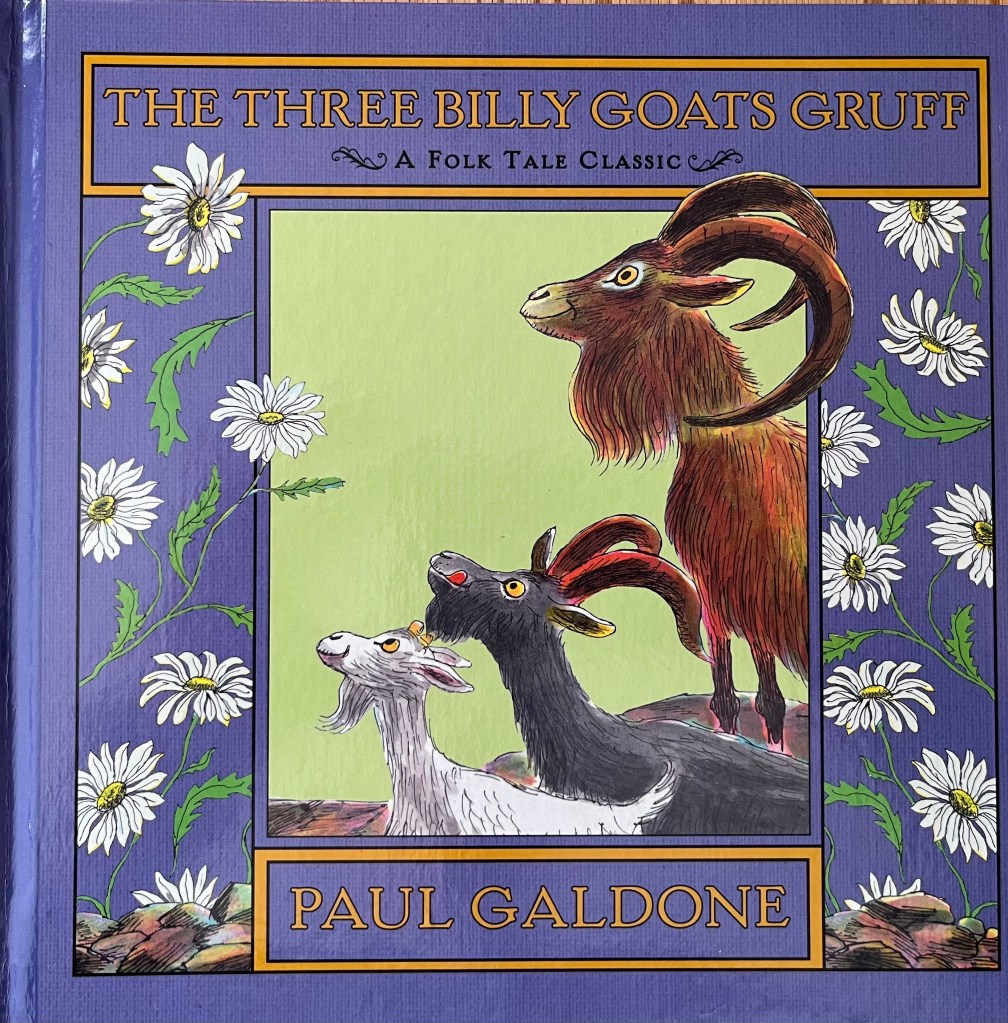
On day two, I do an oral retelling of the story using felt board characters. It is possible to do without props as well. I encourage the students to join in with the retelling, especially during repeated refrains. As I retell, I wonder aloud what I should call the goats. In the Galdone version of the story, he uses “tiniest, second, and big” to describe the goats. I also think back to The Three Bears when Galdone used “Little wee, Middle-sized, and Great big” to describe the bears. The students are happy to suggest words such as itsy-bitsy and enormous to describe the goats. When we finish the retelling, we decide to categorize all the size words mentioned on poster paper and hang the poster in the writing center.
Day two is also a great time to highlight a few interesting words you noticed in the story. In this book, Paul Galdone describes the river as “rushing.” We discuss the meaning of ushing in different contexts and come up with a hand gesture, moving one arm across the body quickly. I intentionally use the word rushing as I retell the story with my felt pieces. Each goat crosses over the rushing river, and the troll falls into the rushing river. I also intentionally use rushing in other contexts throughout the day. For example, I might mention to the students that in the morning, I am often rushing to get ready so I am not late for school. When I highlight words intentionally, the students get excited about these big words too. The students point out when they hear a former vocabulary word almost daily. I love it!
I also begin to add materials to the learning environment that might inspire storytelling and the use of rich language in play. I added my felt board and pieces to my library corner. I also decided to create a storytelling invitation for my light table.
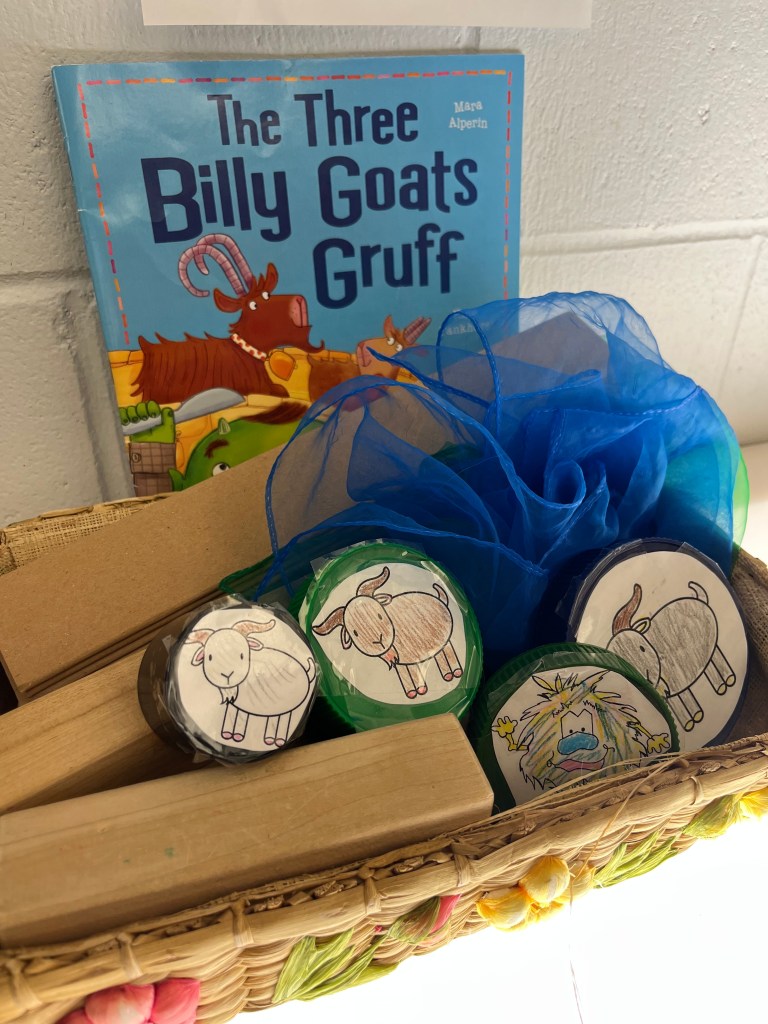
I didn’t have any stuffed goats or figurines, so I used plastic lids of various sizes to make three goats and a troll. We had been exploring solid shapes in math and thinking about curved versus flat surfaces, as well as whether or not and how a shape rolls or slides. I was inspired by cylinders rolling, so I set out some cardboard pieces and blocks, thinking the kids might build a bridge for the story. I also set out the blue scarves, thinking of the rushing river.
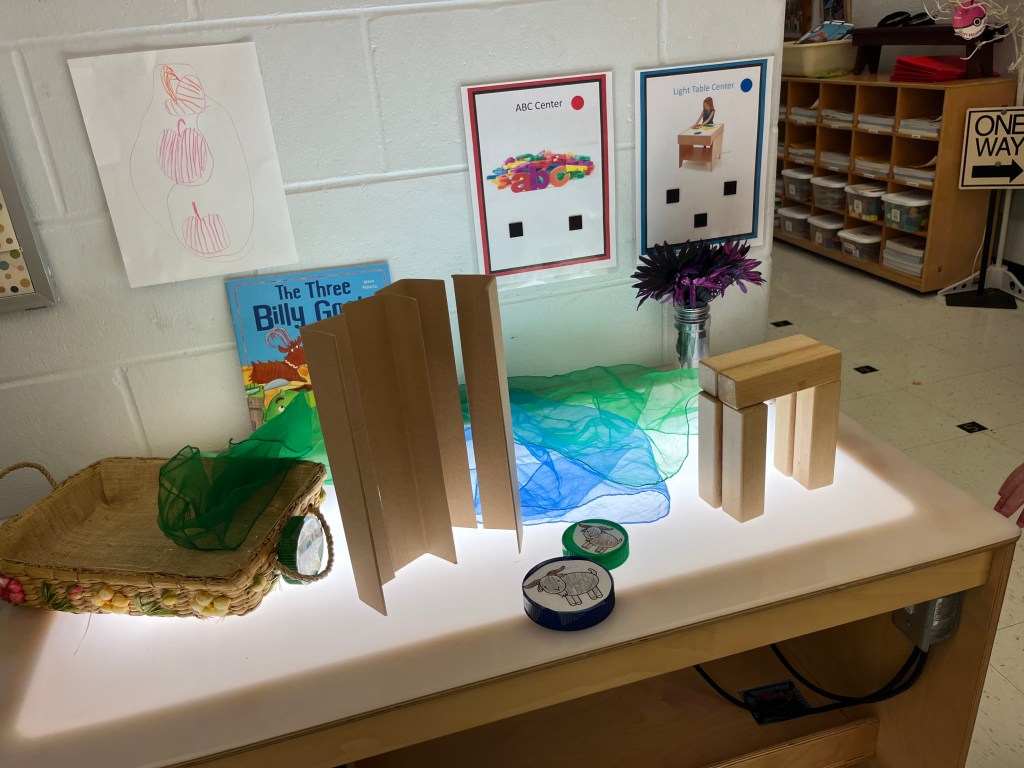
I immediately had some takers. They were curious about the alternate version of The Three Billy Goats Gruff I had included. They looked through the book, already beginning to make comparisons and asking me to read this new version to them. They set out the scarf as a river and built a bridge with the blocks. I began to hear some storytelling taking place.
Another child wandered over soon and began setting up the scene in a new way.
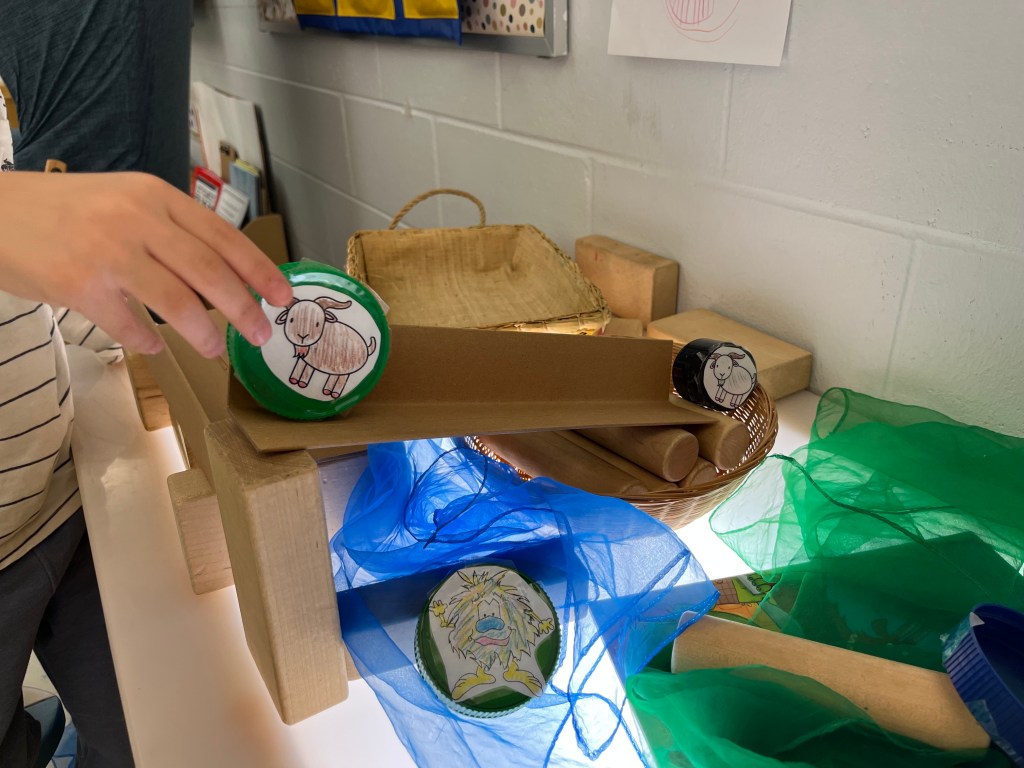
As I had hoped, this child set the cardboard piece at an incline and tried to roll the goats down his bridge. While the goats did not roll as well as I had anticipated, the students used creative thinking and rich storytelling language as they engaged with the open-ended materials.
On day three, we take a deeper dive into story elements. We discuss the characters, setting, problem and solution in the story. All of these elements are easy for the students to name, especially after hands-on opportunities to engage with the story. We compare characters within the story or with other stories. We used a Venn diagram to show how the similarities and differences between the troll and the big bad wolf (from The Three Pigs). I like to make a large Venn diagram on my Promethean board and draw pictures for their responses. You could also give students their own Venn diagram graphic organizer to record ideas too.
On day four, I read another version of The Three Billy Goats Gruff, upon request from the students. As I read, everyone was ready to compare these two versions. The students noticed similarities as small as word choice; both authors used rushing to describe the river and roared to describe the troll’s voice. They also noticed small details in the story, as well as in the illustrations that were the same and different. I love how closely the students pay attention to detail when they are excited about a book.
On day five, I usually do some sort of assessment- including comprehension and vocabulary. I might also ask if the kids want to act out the story, asking students or small groups of students to play each part while I play the part of the narrator.
 Mrs. Coomber's Kinderland
Leave a comment